智能供暖控制器:得益于智能家居
A 智能家居中的联网供暖控制器可提升居住舒适度和效率。毕竟,智能供暖系统会自动确保适宜的舒适温度,同时避免浪费能源。

A 联网供暖系统可通过 app 或语音助手进行控制,并巧妙地集成到您的智能家居中。它会自动调节温度——兼顾效率与居住舒适度。简而言之:如果供暖控制器能根据测量值、编程或场景进行智能响应,您的家就会更温馨、更舒适,同时您还能节省供暖成本。谁会不喜欢这样呢?好消息是,大多数供暖系统都可以快速、轻松地升级为智能控制系统。下面我们将为您揭示其工作原理,以及哪些功能温暖的不只是您的心。
您可以在这里了解智能家居中供暖控制器的优势。

A networked heating control system ensures greater comfort and measurable energy savings. With intelligent sensors and individual schedules, the heating output automatically adjusts to your actual needs. You can then conveniently control your heating system via an app while on the move or integrate the control system into your smart home. You can then add both temperature and humidity sensors or integrate a window sensor, for example.

The Shelly BLU TRV is best used as a smart heating controller. If your heating controller can be controlled smartly, you have the option of setting up networked scenes. We explain how to do this below. The following example scenario makes ventilation particularly efficient: you specify in the Shelly Smart Control app that the heating in the bathroom should be switched off if the Shelly BLU Door/Window window sensor in the same room reports that ventilation is in progress. The BLU TRV obeys and automatically reduces the heating system when the window opens. This means that your heating control runs particularly efficiently and no heat is wasted.

The Optimum Temperature varies depending on the room. While a pleasantly warm 20 to 22 degrees is usually preferred in the living room, a cooler 16 to 18 degrees is often sufficient in the bedroom. Humidity also plays a decisive role, as it influences the indoor climate and mold growth. If the air is too dry or too humid, even the ideal temperature can be perceived as uncomfortable. For living comfort and mold prevention, you couple your heating controllers with Shelly H&T Gen3 or BLU H&T temperature and humidity sensors. They precisely record the current values and automatically adjust the heating output based on the scene you have previously defined.

How easy is it to adapt the heating times to your daily routine? With Shelly: super easy. In the Shelly Control app, you can set the heating to be turned up in the morning before you get up, for example, and automatically turned down as soon as everyone leaves the house. In the evening, the heating system welcomes you back to your comfort temperature. This prevents unnecessary heating and saves energy and costs. The only thing you need to do is create the scene in the app beforehand.

Of course, you can also control your heating system directly - there are various ways to do this. You can control your heating controller in the smart home from the Shelly Control app or with a linked voice assistant. "Alexa, set the heating to 22 degrees" is enough for the helpful assistant to turn up the temperature for you. Alternatively, you can use the Shelly Wall Display + H&T to set the heating system to a comfortable temperature. It measures how warm and humid it is in the room and automatically adjusts the output according to the stored scenes. Of course, you can also control the heating controllers in your smart home directly via the Wall Display. You always have the temperature and humidity directly in view.

Now that you are aware of the numerous possibilities, we don't want to leave you in the dark about how you can make your heating smart. Converting radiators is particularly easy: to be able to control the heating controller smartly, you can simply replace your analog radiator thermostat with a networked model. To do this, unscrew the old controller and replace it with a smart heating controller, such as the Shelly BLU TRV. It networks every conventional radiator and allows you to integrate it into your smart home - because it comes with the Shelly Gateway Gen3.

If you want to heat your home to a comfortable temperature using underfloor heating instead of radiators, you don't have to do without intelligent heating. Shelly has simple solutions for this too. For example, the BLU TRV plus Gateway Gen3, which is also connected directly to the heating system, is suitable. Either the Shelly 1 Gen3 actuator or the Shelly 1 Mini Gen3 is used to control the heating system motor - depending on how many amps are supported. The analog thermostat of the underfloor heating system can simply be replaced by the Shelly Wall Display - and control is automatic, via app or voice assistant.

Smart control also makes sense for electric heating. After all, it consumes a relatively large amount of electricity. Intelligent heating control makes it easy to save energy. A Wi-Fi socket such as Shelly Plug S Gen3 is used for networking. They enable smart control of the connected devices via WLAN. You can then define that the heating only comes on when it gets colder than 18 degrees in the room during the day, for example. To do this, the smart socket must of course communicate with a corresponding sensor, such as the Shelly H&T Gen3. If the room in question is used as a home office, the heating only heats during working hours.
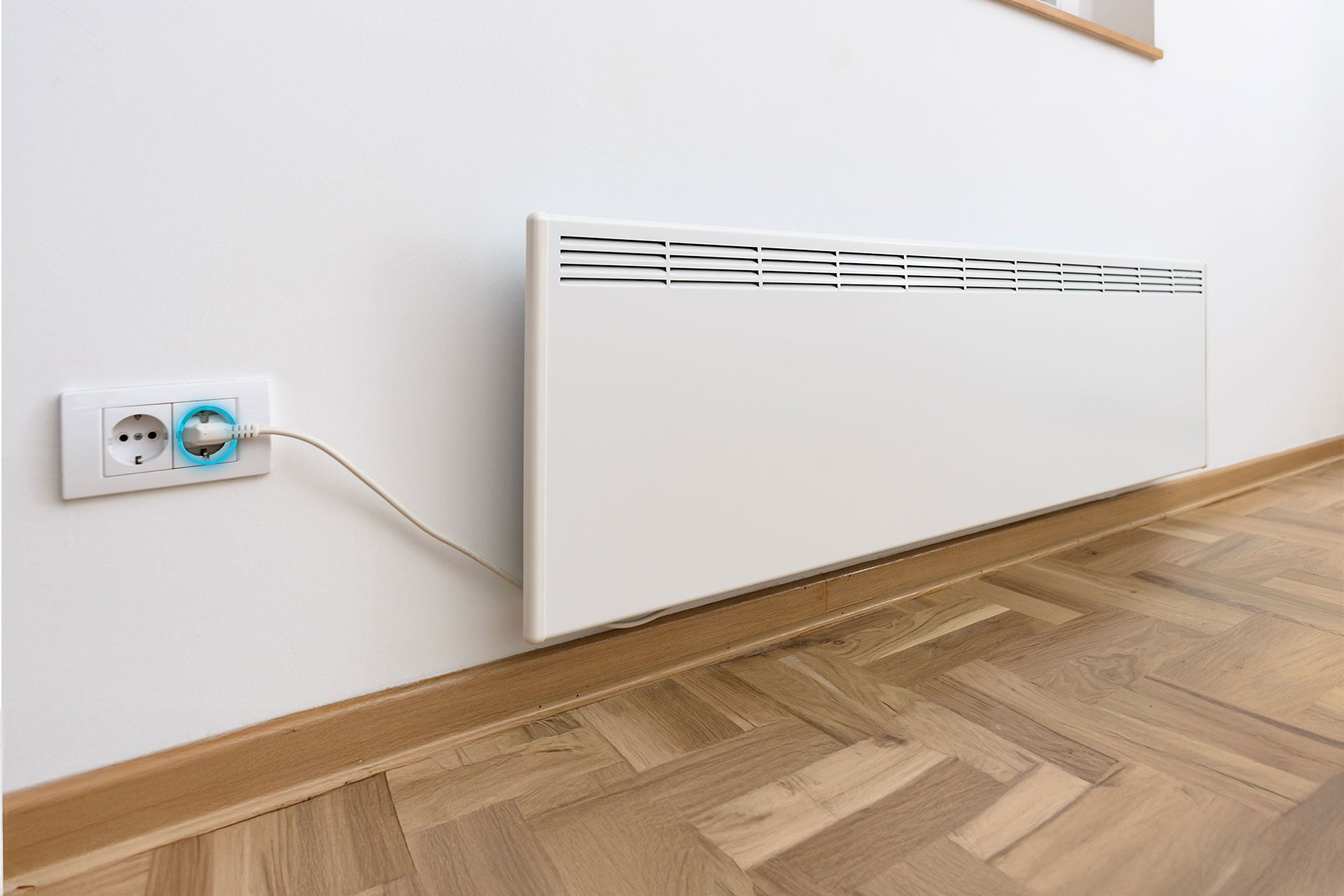
With the help of Shelly Solutions, you can efficiently control and optimize energy consumption in the entire household. For example, you could always switch on the electric heating when the solar system is producing a lot of electricity or manage the hot water preparation on a time-controlled basis. Networking an electric heating system also makes sense in combination with dynamic electricity tariffs. Energy-intensive processes such as the operation of the electric heating can then be shifted to favorable times.

Let's assume we want to set up temperature-controlled automation in the Shelly Smart Control app and use a Shelly H&T Gen3 and the Shelly BLU TRV thermostat. The two devices are first added to the app and connected within a scene. To do this, simply create a new scene and define the trigger under "If". This condition could be that the H&T Gen3 measures a temperature of less than 20 degrees in the living room. The "Then" condition would be that the Shelly BLU TRV switches on the heating. Conversely, a temperature of more than 24 degrees could trigger the heating to switch off automatically.

智能暖气片恒温阀非常实用,因为它们能够提高能源效率和居住舒适度。它们也易于改装。
任何供暖系统都可以联网。具体需要哪些组件,取决于相关供暖系统的类型。
A 室温温控器可为多个房间提供集中温度控制,而暖气温控器可灵活地对各个散热器进行单独控制。因此,暖气温控器更具优势。
大多数都可以更换。机械式暖气片温控阀通常无需工具即可更换,而电子式或壁挂式型号则需要专业知识。